.

Wednesday, August 17, 2011

Postage stamps of Pakistan - 1969 from my collection


Chitagong, East Pakistan has the distinction of having on its soil the first steel mills of Pakistan. On the eve of its inauguration, Pakistan Post issued a 15 Paisa stamp showing the building of the steel mills on 7 January 1969.
Pakistan Post issued a 15 Paisa stamp on the theme of Family Planning on 14 February 1969. The purple and blue stamp ironically coincided with the Valentine's Day. 
Pakistan rose to prominence in the field of hockey when it bagged its first Olympic gold in the 1960 Rome Olympics, but lost the title to India in 1964 Tokyo Olympics.  The 1968 Olympics at Mexico thus become important for Pakistan to regain the lost title. The team under famous Olympian Tariq Aziz worked very hard and clinched the title from India and became the Olympic champions in hockey. India finally settled for a bronze.

The honour coincided with the on-going celebrations of the Decade of Development by the then regime of president Muhammad Ayub Khan.  The president immediately sent a telegram to the skipper in which he said, “I heartily congratulate you and all members of your team on their grand victory in the Olympic Championship. This is a tribute to your team spirit, dedication and skill. Pakistan is proud of your superb performance."

To commemorate the glorious victory, Pakistan Post issued a set of two stamps on January 30 as shown above, valued Paisa 15 and Rupee 1. The stamp showed the Olmpic gold medal and a hockey player with the caption of Mexico Olympics 1968 alongside the Olympic rings.
On the eve of the death centenary of the famous Urdu language poet of the united India Mirza Asad Ullah Khan Ghalib, Pakistan Post issued a set of two stamps of value Paisa 15 and 50. The stamps bore the typical portrait of Mirza Ghalib on the right enriched with Moghul floral border  and a selection of verses from his poetical masterpiece.

The translation of the verse on 15 Paisa stamp reads:
Where, O God, does the next step of Passion lead,
The Wilderness of corporeal universe appears But a foot-print to me

The translation of Ghalib's verse on 50 Paisa stamp is as under: 
A loftier abode we fain had created
O that for us a residence beyond the stars had been destined
The above stamp valued at Paisa 15 showing the new railway station of Dacca was issued on completion of its first year on 27 April 1969.
A set of two stamps, valued at Paisa 15 and 50 was issued on the eve of 50 years of the International Labour Organization ILO. The stamps green and red in colour were issued on 15 May.
To mark the Fifth Anniversary of the establishment of the Regional Co-operation for Development (RCD), the Pakistan Post Office issued a set of three commemorative postage stamps of 20 Paisa, 50 Paisa and Re. 100 denominations on the 21st July, 1969. The stamps reflected the cultural heritage of the three member countries.

The 15 Paisa stamp on left above had the reproduction of a Mughal Miniature painting belonging to the mid 18th Century. The painting depicted the portrait of a woman seated in a balcony, holding a cup in her hand and wearing a tall bejeweled hat on her head, from which her hair cascaded on her shoulders. The stamp reflected the art of Pakistan.

The 50 Paisa stamp in the centre above depicted the Safavi miniature art of Iran, showing a kneeling servant. The painting was done by Raza Abbasi who lived in the first half of the 17th Century and was one of the well-known Safavi (Isfahan) miniaturists.

The Rupee 1 stamp on the right above showed the miniature art of the Ottoman Empire's times and displayed the Suleiman the magnificent's court. The miniature seems to have been taken from “The Book of Exploits”compiled in the year 1588. 
On the eve of the commissioning of the first oil refinery in East Pakistan, a commemorative stamp of value Paisa 20 was issued on September 14, 1969. 

The refinery named Eastern Refinery Ltd., was been built in collaboration with the East Pakistan industrial Development Corporation and the Burmah Oil Company Ltd., London. Built at a cost of Rs. 13.5 crores, the Eastern Refinery had the designed capacity to process 1.5 million tons of crude oil annually. This was yet another hallmark of the Decade of Development of president Ayub Khan.
The above stamp of 20 Paisa denomination was issued on 6 October on the eve of the Universal Children Day.
A set of two stamps was issued on November 1, 1969 on the occasion of inaguration of the Dacca - Tokyo route, labelled the Pearl Route by the national flag carrier Pakistan International Airlines (PIA).

The stamp valued Paisa 20 (green in colour) and Paisa 50 (blue in colour) showed a Japanese doll on the left side of the stamp against the three panelsn. The top panel bore the caption “PIA PEARL ROUTE INAUGURAL DACCA-TOKYO”, while the lower panel showed the value of the stamps. The central panel displayed the map of the world with black lines marking the diferent destinations of PIA.

The route was labelled as Pearl Route for the reason that Dacca is known for its pink pearls and Bangkok for precious stones. Manila is the capital of the Philippines which is called the Pearl of the Pacific and Tokyo is internationally famous for its cultured pearls.
The name of Abu Ali Al Hasan ibnul Hasan ibn al-Haitham (Alhazen) for his monumental achievements in the science of optics is well known around the world.Born in Basra in 965, he moved to Cairo which was then the hub of the Islamic world and a great centre of learning. His brilliance in the field of mathematics was picked up by the Fatimid caliph and was called to the royal courtyard. Haitham had many contributions including the proposal of building of a dam on River Nile that would create destruction each year around its banks. It was many centruies later that the famous Aswan Dam was built and relaised Haitahm's dream and brilliance.

However his greatest discoveries are in the field of ptics and he wrote a book "On Optics" or Kitabul Manazir. In the book, he came up with the thoery of Euclid and Ptolemy that the eye sends out visual rays to the object of vision. He proposed, “It is not a ray that leaves the eye and meets the object, that gives rise to vision. Rather the form of the perceived object passes into the eye and is transmitted by its transparent body (i.e. the lens)." 

His contributions in science are countless which require thousands of pages to fathom each. On the eve of the 1000th anniversary of Ibn-e-Haitham, Pakistan Post issued a stamp of Paisa 20 value on November 4, 1969. The multicoloured stamp bore his theory of Reflection of Light, drawn by him.
The last stamp of the year was issued to commemorate the 50 years (1919-1969) of the first aeroplane flight from London - Australia on 2 December 1969. The mainly blue coloured 50 Paisa stamp showed the famous Vickers "Vimmy" aircraft and the route of the first flight showing London - Karachi (now in Pakistan) and Darwin in Australia, the end destination.

It may be added here that in March 1919 the Australian Government had offered a prize of £10,000 for the first aeroplane to fly from England to Australia. The race was won by the “Vickers Vimy biplane commanded by Sir Ross Smith, with his brother Lieutenant Keith Macpherson Smith as co-pilot and mechanics Sergeant W.H. (Wally) Shiers and J.M. (Jim) Bennett, who took off from England on November 12, 1919 and reached Australia on December 10, 1919 after making brief stop-overs at various places including Karachi. 

Related:
The stamps issued on eve of Decade of Development -1968
The decade of development
England to Australia Flight (Wikipedia)

Thursday, August 11, 2011

Postage stamps of Pakistan - 1968


1968 marked the 10 years of the rule of President Muhammad Ayub Khan. The occasion was celebrated as the decade of Development throughout the country. The then government was rightly proud of its achievements as never in the history of Pakistan, the country had been so stable, progressive and developing. During these 10 years, Pakistan achieved many a hallmark, like the building of new capital city Islamabad, ushering in the TV era (first TV station set up in Lahore 24 November 1964), inauguration of first electric train between Lahore and Khanewal (though no successive government could extend it an inch thereafter), besides providing stability and immense economic growth to the country. the establishment of the Pakistan Institute of Nuclear and Scientific Technology was another hallmark achievement of the government that later paved way for Pakistan to become a nuclear power state. In 1961 Warsak Dam was built near Peshawar to become the first major water storage reservoir of the country. Later two major mega projects namely the Mangla and Tarbela Dam were added to produce electricity and store irrigation water.

During these 10 years, Pakistan's relations with the western world improved manifold. In 1964 Ayub Khan became the first head of the state to visit China - a visit that could never be replicated later by any other head of the state. The visit laid the foundation of very friendly and strong ties between China and Pakistan. China since then has become a time tested friend of Pakistan and has always supported Pakistan on all issue on the international forum.

The first set of two stamps that were issued in 1968 was issued on January 31 on the eve of the International Year of the Human Rights. The two stamps of Paisa 15 and 50 displayed the emblem of the Human Rights ad were blue and yellow in colour respectively. 
The second stamp of the year was issued on 28 March on the eve of the First Convocation of the East Pakistan's Agricultural University. The stamp showed the building of the university and Memonsingh. 
The third issuance was a set of two stamps on April 7 to celebrate the 20th anniversary of W.H.O. The stamps were priced at Paisa 15 and 50 and were of green and orange red and red, orange and indigo in colour respectively. There were some rare stamps of Piasa 15 on which the word PAISA was written as PAIS, with letter "i" omitted. 
Kazi Nazrul Islam (25 May 1899–29 August 1976) was a Bengali poet, musician and revolutionary who pioneered poetic works espousing intense spiritual rebellion against fascism and oppression. His poetry and nationalist activism earned him the popular title of Bidrohi Kobi (Rebel Poet). Accomplishing a large body of acclaimed works through his life.

Surcharged Stamps: On 18th July four previous stamps issued in 1951 and 1955 were reissued with their denomination in struck out with new denomination of paisa 4, 60 and 80:


On 25 June 1968, a set of two stamps was issued of value Paisa 15 and 50 to honour the great man. 
On 7 October, on the eve of the Universal Children Day, a commemorative stamp of Paisa 15 was issued with the theme for the year "Good Health - the Basic Right of Every Child" and three children shown running with hoops. 

To commemorate the Decade of Development, a set of four stamps was issued on 27 October as shown above. The stamps were valued 10, 15, 50 and 60 Paisa. the 10 Paisa stamp (top left) showed the National Assembly building, the 15 Paisa stamp (bottom left) showed agriculture produce, the 50 Paisa stamp (above right) was dedicated to the armed forces of the country and the 60 Paisa stamp (bottom right) showed industrial plants and the atomic reactor.


If you like My Philatelic World, please join us at Facebook

Sunday, August 7, 2011

Postage stamps of Pakistan - 1967 from my collection

1967 was a busy year for the Pakistan Post as it issued stamps on almost a dozen occasions during the year. Starting from the very first day of the year, the Pakistan Post issued a 15 Paisa value stamp (below) on the eve of the International Tourist Year in January 1, 1967. 
The brownish coloured stamp bore the emblem of the Tourist Year.
The second stamp was again issued in the month of January on the eve of the TB eradication campaign. The Paisa 15 stamp bore the emblem of the TB Association of the country and was issued on January 10, 1967.
The third stamp was also issued in the month of January, on January 29 to commemorate the holding of the 4th Pakistan National  Boy Scouts Jamboree. The Paisa 15 value stamp bore the badge and typical three fingered salute of the boy scouts.
17th February marked the centenary of the West Pakistan High Court. The 15 Paisa value stamp bore the emblem of the High Court and the woman holding the scale of justice in her right hand.
Dr Sir Muhammad Allama Iqbal is the national poet of Pakistan. 21 April marks the death anniversary of this poet philosopher. On the day, a set of two stamps was issued to pay homage to this great poet who dreamt of a separate homeland for the Muslims of the British India and brought on board Muhammad Ali Jinnah to lead the movement for the Muslims of the subcontinent. Unforgettably, he could not see his dream coming true as he expired almost nine years before the independence of Pakistan.

The stamp on the left above was priced at Paisa 15 and was dominating light red and sepia in colour. The Re. 1 value stamp on the right was dominating deep green and sepia in colour.
During the Indo - Pak war of 1965, three cities of Pakistan that bore the major brunt of the enemy's aggression and blunt all efforts by the enemy forces to take over cities of Lahore and Sialkot due to gallantry of the Pakistan army and resilience of the people of the two cities. Sargodha being a major air force base was also subjected to incessant air raids from across the border, but was saved from any major damage due to gallantry of Pakistan Air Force.

To honour the citizens of these three cities, a special national standard known has Hilal-e-Istaqlal was given to these three cities as depicted on the stamp above. The 15 Paisa stamp with red background showed the special Pakistan standard or the Hilal-e-Istaqlal. Each year on 6 September, the previous flag is replaced with the new one, which flies atop the city town hall building side by side the national standard of the country. 

The stamp above was issued on May 15, 1967.


A 15 Paisa red and blue green stamp was issued on 14 August 1967 to celebrate the 20th anniversary of the independence of the Pakistan as shown above.
On 28th September, a set of three stamps was issued to show Pakistan's three major exports. The Paisa 10 blue, yellow and green stamp above top showed the rice export of Pakistan. Pakistan's Basmati Rice ranks among the very best in the world. The 15 Paisa stamp in the bottom row (left) depicted cotton, yarn and textile exports of Pakistan. Like rice, Pakistan produce one of the finest cotton i the world and its textile related products are like all over the world. The 50 Paisa stamp above (right) showed raw jute, bales and bags winch were peculiar to the then East wing of the country.
The multicolored, yellow dominated stamp above witha face value of Paisa 15 was issue don the eve of Universal Children Day on 2nd October. The stamp showed clay toys for the children.
On 26th October, on the eve of the coronation of the Shah of Iran, a commemorative stamp of 50 Paisa face value was issued showing the portrait of the King of Iran Raza Shah Pehalwi and his wife Queen Farah Deeba.
The 15 Paisa multicoloured stamp was issued on November 4 on the eve of Cooperative Day.
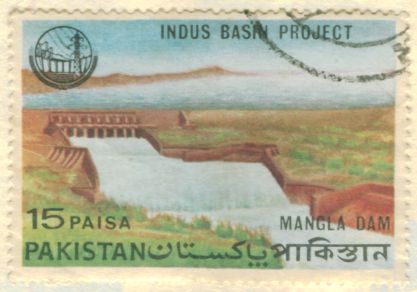
Indus Water Basin Treaty was a hallmark treaty between India and Pakistan, which was signed in 1960 by the president of Pakistan Muhammad Ayub Khan and Indian prime minister Nehru for the just utilization and distribution of rivers flowing into Pakistan from India. as per the treaty, Pakistan was allowed to construct major dams on the Indus and River Jhelum. The 15 Paisa stamp above shows the spillway of the Mangla Dam, constructed near the city of Jhelum on River Jhelum. The stamp was issued on 23 November on the eve of formal opening of the dam. 
The last stamp of the year was issued on December 28. The 15 Paisa red and black stamp showing a crab pierced by a sword to mark the resolve the fight against the deadly disease of cancer.

If you like My Philatelic World, please join us at Facebook

Saturday, August 6, 2011

Pakistan Postage Stamps - 1966: The year of Islamabad Inaguration

On February 13, Pakistan Post issued a multicoloured 15 Paisa stamp to mark the armed Forces Day. The stamp with yellow background had emblems of all three branches of the armed Forces of the country.
On the eve of the inauguration of the first atomic reactor of the country, under the auspices of PINSTECH (Pakistan Institute of Science and Technology), located at Nilore near Islamabad. The institute was to become a hallmark in the history fo Pakistan which later paved way for further development and research on atomic power in the country. The 15 Paisa stamp showed the elevation of the PINSTECH building was issued on April 30, 1966.
Habib Bank Limited was the only bank in the private sector on the eve of creation of Pakistan. On august 25, a multicoloured stamp showing the emblem of the bank was issued on the eve of its 25th year of operation.
A red and yellow coloured stamp (above ) of 15 Paisa face value was issued on October 3, 1966 to commemorate the International Children Day.

On the eve of the 20th anniversary of UNESCO, a 15 Paisa stamp was issued (below) on November 24. The stamp displayed the emblem of UNESCO.

President Muhammad Ayub Khan had a dream of building a capital city for Pakistan. The work on the project started under the foothills of Margalla Hills near Rawalpindi in 1960 and the capital was formally inaugurated in 1966. 
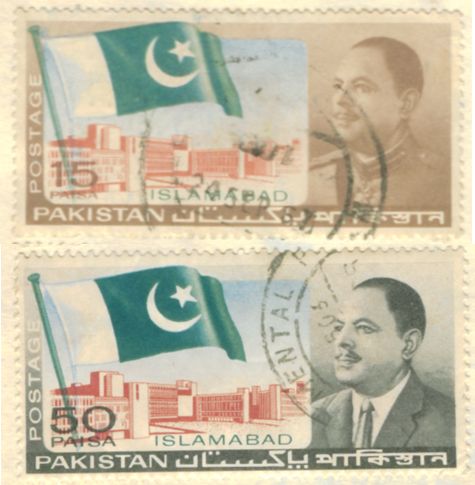
On November 29, Pakistan Post issued a set of two stamps priced at 15 and 50 Paisa respectively as shown above on the formal inauguration of the new capital. The stamps displayed the Pakistani flag, the federal secretariat building and photos of president Ayub Khan both in uniform and in suit.

-->

The Capital Development Authority (CDA) is celebrating the 50 years or the Golden Jubilee of the day this year. 
On the foundation of the Health and Tibbi Research Institute, a 15 Paisa dull green and salmon coloured stamp was issued on December 3. The stamp displayed the portrait of famous Muslim scholar and researcher Avicenna or Abū ʿAlī al-Ḥusayn ibn ʿAbd Allāh ibn Sīnā. Ibn-e-Sina, as he is commonly known has great contribution in the field of medicine. 
The last set of two stamps of 1966 was issued on December 25 to commemorate the 90th birth anniversary of Muhammad Ali Jinnah, commonly known as the Quaid-e-Azam, the founder of Pakistan. The two stamps valued at 15 and 50 Paisa showed the portrait of the father of nation wearing the famous Jinnah Cap or the Karakul Cap, which became the national headdress of Pakistan.
If you like My Philatelic World, please join us at Facebook

Twitter Delicious Facebook Digg Stumbleupon Favorites More