.

Monday, July 25, 2011

Postage stamps of Pakistan issued in 1963

This 13 Paisa stamp earlier issued in 1962 (with redrawn Bengali script) was over printed with words "U.N. FORCE W.IRAN" on 15 February 1963.


Horse and Cattle Show at Lahore Fortress Stadium has been one of the major events to welcome the spring and had been held for years in the months of March and April. The 13 Paisa stamp above was issued on 13 March 1963. The stamp shows the dancing camel and horse with a drum beater in between and a cow underneath. 
A set of two stamps was issued on March 21, 1963 on the eve of promulgation of the land reforms. The 13 Paisa stamp was in orange brown colour, while the 50 Paisa stamps was in bistre brown colour. 
On the eve of the International Stamp Exhibition in Dacca, an earlier issued stamp of 2 Ana denomination with maps of East and West Pakistan (1960) was overprinted with words "INTERNATIONAL DACCA STAMP EXHIBITION 1963". The stamp was issued on March 23 and revalued at 13 Paisa, since Pakistan switched over to decimal system in 1961. 
On the eve of the centenary of the Red Cross, a 40 Paisa stamp in red and deep olive colour was issued on June 25, 1963. 
Pakistan is rich in archaeological remains of the civilizations that once thrived in the areas that now constitute Pakistan. From Mehrgarh civilization (7000-9000 BC) to Meonjodaro and Taxila (2500 BC), there are numerous remains that are now protected by the UN. The 13 Paisa stamp in sepia colour on top shows remains of Moenjodaro. The blue 7 Paisa stamp on left shows Paharpur archaeological site, located in the Khyber Pakhtunkhwa province. The 40 Paisa carmine colour stamp shows stupa of Taxila. The deep redish coloured 50 Paisa shows remains of Mainamati, a Buddhist site near the city of Comilla in East Pakistan (now Bangla Desh). The set of four stamps was issued on September 18, 1963. 
Public Works Department (PWD) was established by the British during their rule over the British India in 1863. On October 7, 1963 on the eve of the centenary celebrations of this pre-independence department, an earlier issued stamp of 3 Paisa in 1961 was repriced at Paisa 13 with overprint "100 YEARS OF P.W.D OCTOBER, 1963". The stamp had the older version of Bengali script which was later changed in 1962. 
Mustafa Kemal Attaturk of Turkey is revered in Pakistan as both Pakistan and Turkey enjoy the best of brotherly relations. On the eve of 25th death anniversary of this great Turk leader, a 50 Paisa stamp showing the Ataturk’s Mausoleum was issued on 10 November 1963. The stamp was red in colour. 
On the eve of the 15th anniversary (1948-1963) of the Universal Declaration of Human Rights, a 50 Paisa stamp was issued on December 10, 1963. 
The last stamp of the year was issued on December 25, 1963 to mark the completion of the Multan Thermal Power Station. The Paisa 13 stamp was ultramarine in colour and showed the overview of the building.

If you like My Philatelic World, please join us at Facebook

Saturday, July 23, 2011

Pakistan Postage Stamps - 1962 from my collection

On the eve of Pakistan International Airlines' first jet flight from Karachi (west Pakistan) to Dacca (East Pakistan ), an earlier issued scarlet coloured stamp with a denomination of two and a half Ana in 1957showing Karnaphuli Paper Mill East Pakistan. was over printed with words "First Jet Flight karachi - Dacca" was issued on 6th February. The stamp was repriced at 13 Paisa as in 1961 Pakistan switched over to the decimal system. 
On 7 April 1962, a s et of two stamps was issued on the eve of Malaria Eradication campaign. The stamps were priced 10 and 13 Paisa.


On 8 June 1962, a commemorative stamp of 40 Paisa face value was issued on the eve of formulation of the new constitution of the country. The stamp printed by Courvoisier S.A. Switzerland showed the Jasmine flower (national flower of Pakistan) and maps of East and West Pakistan.

On the eve of Independence day 14 August 1962, the theme chosen was Sports in the country. The set of four stamps was priced at Paisa 7, a black and blue stamp showing football, Paisa 13, a green and black stamp showing hockey, Paisa 25, stamp in black and purple showing squash raquets, and finally a Paisa 40 stamp of  black and orange brown colour showing cricket bat.  After Cape Verde, Pakistan became the second country in the world to have a stamp showing a cricket bat. 


Small scale industries of Pakistan are the backbone of Pakistani industry supporting the handicrafts of the country. A set of five stamps was issued on 10 November 1962. The 7 Paisa stamp in brown lake colour showed a marble fish plate, the 13 Paisa deep green stamp showed the sports industry, 25 Paisa stamp of reddish violet colour displayed the camel skin lamp, the 40 Paisa yellow green stamp the wood industry and finally the 50 Paisa deep red stamp showed an inlaid cigarette case. The stamps were designed my MunirBhatti and Ashfaq Ghani.
Pakistan continues to issue stamps on its handicrafts and other industries as can be seen in Pakistanpaedia.

On the 16th anniversary of the UNICEF, Pakistan post issued a stamp of two stamps on 11 December 1962 as above. The stamps depicted a book, toy and medical instrument and were of 13 and 40 Paisa denomination.


The earlier issued set of the definitive stamps of 1961 undergone yet another change with re-drawn Bengali inscription from the left to new inscription as seen on the stamp on the right. The change was effected to the entire range of these stamps and continued to be used till these stamps were withdrawn.

Originally shared at Hobby Shobbys

Sunday, July 10, 2011

Pakistan Post switches over to decimal system - 1961

The dawn of 1961 ushered in a new era in the history of Pakistan. The age old Ana denomination was replaced by the decimal system as Pakistan switched over to the metric system. Now instead of One Pakistani Rupee having 16 Ana or 64 Paisa, from 1 January 1961 was to equal 100 paisa. Since there were no readily available stamps of decimal system, the stamps issued in previous years were overprinted with the new price in Paisa.


The year 2011 also marks the 50th anniversary of the event - time passes so quickly.

The stamps with paisa overprint that were used were as shown above: the Justice Scale series of 1948 re-priced 2 Paisa, the Crescent stamp 1956 re-priced 13 Paisa, the Badshahi Mosque re-priced 7 Paisa and Jahangir Mausoleum 1954 re-priced 1 Paisa and West Pakistan map series of 1960 re-priced 3 and 13 Paisa. 


From 1961-63, a series of definitive stamps was issued, but in the earlier issues, the word "Pakistan" was erroneously written as "Shakistan" in the Bengali text as in the above series of stamps. The mistake when observed, was later corrected in the stamps as shown herein under. 
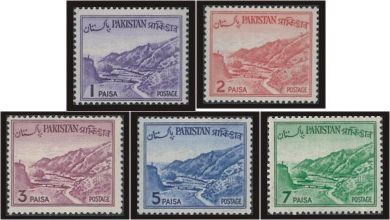
This is the corrected series of stamps with Pakistan correctly spelt in Bengali text. The stamps showing the famous Khyber Pass were of the denomination of Paisa 1,2,3,5 and 7. 
Continuing with the definitive series of stamps between 1961-63, the second set of stamps bore the photo of the famous Mogul architecture of Shalimar Gardens of Lahore. The stamps were of Paisa 10,15,25,40,50,75 and 90 denomination.  
The next set of defintive stamps was a set of four stamps showing the entrance of the famous Chhota Sona Mosque of East Pakistan (now Bangla Desh). The stamps were of 1, 1.25, 2 and 5 rupees denomination. 
On the eve of the Lahore Stamp exhibition, the earlier issued stamp of West Pakistan map was overprinted with Lahore Stamp Exhibition 1961 and was issued on 12th February 1961 as seen above left. The stamp on right above was issued on 1 July 1961 on the eve of completion of Warsak Hydro Electric Project - the first ever project of Pakistan to produce electricity by constructing a dam on Kabul River near the town of Warsak, Peshawar. The stamp had a face value of 40 Paisa. 
On 2 October 1961, a set of two triangular stamps (above top row) was issued on the eve of the Child Welfare Week. The turquoise blue stamp had a face value of 13 Paisa, while the bright purple stamp was priced at 90 Paisa. On 4 November 1961, a set of two stamps (above bottom row) on the Cooperative Day. The rose red and deep green stamp (right) was priced 13 Paisa, while rose red and blue stamp (left) had a face value of 90 Paisa. 
On the eve of the Police Century on 30 November 1961, a set of two stamps (above) was issued bearing the Police crest and Traffic Control. The silver black and blue stamp (above left) was priced at Paisa 13, while the silver black and red (left) was priced at Paisa 40.
The last stamp to be issued in 1961 was on the eve of the Railway Centenary (1861-1961), which were issued on 31 December, the last day of the year 1961. The 13 Paisa stamp on the left above showed a steam locomotive engine (known as Eagle)that pioneered the commencement of railways system in the Indo-Pakistan subcontinent. The 50 Paisa denomination stamp on the right above showed a diesel locomotive engine.

Related: Pakistan Post (Pakistanpaedia)
If you like My Philatelic World, please join us at Facebook

Friday, July 1, 2011

UNPA commemorative stamps on ECOSOC-Education-2011


On 1 July 2011, the United Nations Postal Administration (UNPA) issues a set of six commemorative stamps on the theme "ECOSOC (Economic and Social Council) - Education".
Education is a fundamental human right and essential for the exercise of all other human rights. It promotes individual freedom and empowerment and yields important development benefits. Education is a powerful tool by which economically and socially marginalized adults and children can lift themselves out of poverty and participate fully as citizens. Yet millions of children and adults remain deprived of educational opportunities, many as a result of poverty.
Each year, the Economic and Social Council holds an Annual Ministerial Review (AMR), a vehicle for meeting the UN Millennium Development Goals by the 2015 target date. The 2011 AMR will be held during the High-level Segment of the substantive session of the ECOSOC in July at the Palais des Nations in Geneva, Switzerland.
The theme for 2011 AMR is "Implementing the internationally agreed goals and commitments in regard to education". There has been tremendous progress towards Universal Primary Education (UPE) during the past decade, especially in developing countries. 


Limited access to education, high drop-out rates and grade repetition as well as poor quality of education, however, remain important challenges to the full achievement of this goal. At least 72 million children of school age are still denied the right to education due to financial, social or other challenges, including high fertility rates, HIV/AIDS and armed conflict.
The Education for All (EFA) movement is a global commitment to provide basic quality education for all children, youth and adults. The movement was launched at the World Conference on Education for All in 1990. In 2000, the international community met again in Dakar, Senegal, to affirm their commitment to achieving Education for All by the year 2015. They identified six education goals which aim to meet the learning needs of all children and adults by 2015.
The drive to achieve the EFA goals also contributes to the global pursuit of the eight UN Millennium Development Goals (MDGs), especially MDG2 on universal primary education as well as MDG3 on gender equality in education.

Resource/Reference: UNPA

Twitter Delicious Facebook Digg Stumbleupon Favorites More