.

Saturday, February 19, 2011

6th Population and Housing Census 2011 (Pakistan)


Year 2011 is to be 6th Population and Housing Census year of Pakistan. The last census was held in 1998. Pakistan post has issued a commemorative stamp, in anticipation, with a face value of Rs. 10. The stamp is 60 mm wide and 30.5 mm in height. The stamp has 13c perforations and is printed at Pakistan Security Printing Corporation Karachi and issued on 10 February 2011.

The population of Pakistan in 2009 as per a World Bank report stood at 169,708,303 and is world's sixth most-populous country, behind Brazil and ahead of Bangladesh. As per an analysis Pakistan's urban population expanded over sevenfold during 1950-2008, while the total population increased by over fourfold. In the past, the country's population had a relatively high growth rate that has, however, been moderated by declining fertility and birth rates. The population growth rate now stands at 1.6%.

As per the population clock on Pakistan Census Organization website, Pakistan's population stands at 171875000 at the time of writing this post on 19th February 2011.

Friday, December 10, 2010

A page from my stamp album - France

Monday, November 29, 2010

Pakistan: Changing over to Paisa from Ana

Pakistan changed over to the decimal system in 1960 and all earlier “Ana” stamps needed to be converted to “Paisa” denomination face value. Thus on 1 January 1961, a series of stamps bearing drawing of Khyber Pass and Shalamar Bagh were issued for the face value of 1, 5, 7,10,13,15,20,25,40 and 50 Paisa.

While I was a kid, we would see these stamps most commonly used on the envelopes that would be sent to us by our relatives. That is why I still have a fare quantity of these stamps as duplicates.

The definitive series depicting Khyber Pass and Shalimar Garden, was twice produced during 1961-62. But the postal authorities were not satisfied with the shape of Bengali inscription denoting PAKISTAN. The inscription was redrawn in new style and all paisa values were printed with PAKISTAN in Bengali accordingly altered. Distinction of the new font is a straight line over all the letters resembling PAKISTAN which also connects letters with each other. This beautiful set of stamps remained in use till 1970s.

Related Link: Stamps of Pakistan 1961-1980 (Pakistanpaedia)

Tuesday, October 19, 2010

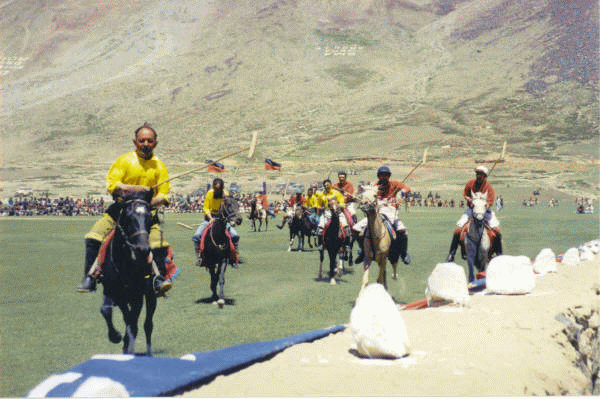
Polo at Shandur – the highest polo ground

Horse is a mighty animal God ever created. Its loyalty and faithfulness attracted it to men, who became its best friends, and masters. The horses not only helped in transportation but also took men to war. But beside that, horses also played when their masters chose to play polo. Played all over the world, the royalties in the Indo-Pak subcontinent also played a game known as Chogan, similar to the game of polo as played today. One of the kings, Qutab ud Din Aibak died while playing polo in Lahore and is now buried in Anarkali - one of the oldest bazaars of Lahore.


While polo is played in all major cantonments of Pakistan, as it is one of the most popular sports in the army, the game at Shandur, 3,700 meters above sea level, near Chitral has a charm of its own. Polo was first played here as far back in 1936, when one Major Cobb, the British Political Agent of then Northern Areas started playing polo at night when it was a full moon, since he thought that moon looked so near the earth that a match in a moonlit night would change the very meaning of the game. Because of this the Shandur polo ground came to be referred to as the "Moony Polo Ground".


The Pakistani-bred Punjabi and Afghan Badakshani ponies, both the result of breeding from Himalayan mountain ponies and English thoroughbreds, are ridden in a wild style, with a lot of skill and at full speed.

Due to its distant location and special climatic conditions, only teams from Chitral and Gilgit participate in the annual Shandur Polo Festival, held in July each year when the snow has melted and the weather is just right for the game to go on. The match is the centrepiece attraction of the Annual Shandur Festival, and a large number of local and foreigners participate in the festivities besides enjoying a hearty polo match.

Watching Polo at Shandur in the full moon may not possible now, but it’s a once in lifetime dream for any polo player to reach to the venue and watch it being played on perhaps the highest polo ground of the world.

To commemorate the game at amid towering snow clad mountains, the Pakistan Post issued a stamp of Rs. 5 denomination in 2006.

Related Reading:
Polo at Shandur (Pakistanpaedia)
Tomb of Qutab ud Din Aibak (Pakistanpaedia)
Chitral (Pakistanpaedia)

Saturday, October 9, 2010

World Postal Day

9th of October is celebrated as the World Post day as it was this day in 1874 when the Universal Postal Union (UPU) was established. In those days, the postal services were in their infancy all over the world and there was requirement to coordinate and harmonize the postal services for the people living in various parts of the world. In other words, the main objective of union was to maintain and create the structure for open flows of the worldwide mail around world.


It was Montgomery Blair, Postmaster General in USA, who prepared the conference of the legislature from 15 American and European countries in 1863, which could be termed as the cue for the establishment of the UPU nine years later. In fact it all started when on September 15, 1874, Heinrich von Stephan, a senior postal official in the then North German Confederation (an area that now forms parts of Germany, Poland and Russia), opened a conference in Berne, Switzerland, with delegates from 22 countries. On October 9, 1874, the delegates signed the Treaty of Berne and established the General Postal Union. The number of countries that were members of the General Postal Union grew rapidly and the union's name was changed to the Universal Postal Union in 1878. In 1948, the Universal Postal Union became a specialized agency of the United Nations.


Today with 189 member countries across the globe, the UPU is the world's largest physical distribution network, that regulates all matters related to post and postal services.


For the last 35 years, UNESCO and UPU have joined hands to organize the global competition of the letter-writing for the young people. Most of the participating postal services use this special day to award the prizes to competition winners.


Like all other countries, Pakistan is also celebrating the day with its postal system that dates back to 1852, when the Scinde Dawk ushered in a new era of postal services for the first time in the South East Asia. To mark the occasion, an impressive UPU-flag hoisting ceremony was organized in the Directorate General, which was attended by a huge gathering of Postal Officer and staff. Despite the era of e-mails and SMSs, the postal services of Pakistan are one of the best, efficient and available in the remotest parts of Pakistan.


Related Links/Reading: Scinde Dawk

A page from my stamp album - Czechoslovakia - Page 2

Czechoslovakia was the name of a country that exisited on world map since 1918. It was initially part of the greater Austro-Hungarian Empire, but later in 1918 after the WW-I, it declared independence and became a sovereign state. The country since then had gone under difficult times of its history. During the period of the WW-II (1939-45), it bore the wrath of the German invasion and was partially incorporated into the then Germany.

After the WW-II, a apart of the Czechoslovakia (to be more precise the eastern part of Carpathian Ruthenia) was taken over by then USSR, while the remaining country continued to be a severing country once again.
Stamps of Czechoslovakia: A page from my stamp album
Since the country mainly consisted of two major parts, i.e. Cesko and Slovensko, the two could not co-exist as one country for long since both were culturally and economically at par with each other. Therefore, after long misunderstandings and bitterness, on January 1, 1993, Czechoslovakia finally split into two independent states: the Czech Republic and Slovakia.


-->


My collection of Czechoslovakia is of the times when the country as Czechoslovakia was intact. I have already shared the first page of my stamp collection of Czechoslovakia. Here is the second page with all its beautiful stamps that I collected from a period from 1966-1975.

Related Reading: A page from my stamp album - Czechoslovakia

Sunday, September 5, 2010

A page from my stamp album - Austria

The postal history of Austria dates back to 1850 when a series of imperforate stamps featuring the coat of arms was issued on 1st of June. Issues between 1858-1861 bore the portrait of King Franz Josef, before returning to the coat of arms stamps again, this time in oval frame. With the establishment of the Austro Hungarian Empire in 1867, King Franz stamps again surfaced. These stamps continued till 1907.

In April 1850, the Austro German Postal Union agreement was struck between Prussia and the Austro Hungarian Empire to provide uniform system of postal rates between the two countries. By 1852, the remaining German states also joined in the Union. This agreement and the establishment of the Postal Union later became a role model for the creation of the Universal Postal Union in 1874.

On the eve of 60th year of reign of King Franz in 1908, a series of stamps depicting portraits of various emperors and Emperor Franz. The same design was used in 1910 on the 80th birthday celebrations of King Franz, showing 1830-1910 at the top and bottom of the stamps. King Franz again reappeared in 1916. From 1917-1919 Emperor Charles I appeared on Austrian stamps.


.

After the World War I, the German Austrian stamps were issued in 1918 with the overprint “Deutschösterreich” on the existing stamps. In 1919 the German Austria issued its own indigenous stamps. The “Deutschösterreich” was replaced with "ÖSTERREICH" in 1922.


The WW-II saw a mixed of stamps as Austria was occupied by the Soviets, Germans and the Allies with overprints of "Österreich" and a bar obliterating the "Deutsches Reich" inscription, bearing portrait of Hitler. On 3rd July 1945, new stamps with "REPUBLIK ÖSTERREICH" were issued by the Soviet Union, while the Allied Military Government issued its own stamps in areas under their control.

After WW-II, Austria started issuing its own stamps.

The first stamp on the top left column of my album is of the period of “Deutschösterreich”. The remaining stamps in the left column are also of the period of WW-II and before.

Twitter Delicious Facebook Digg Stumbleupon Favorites More